
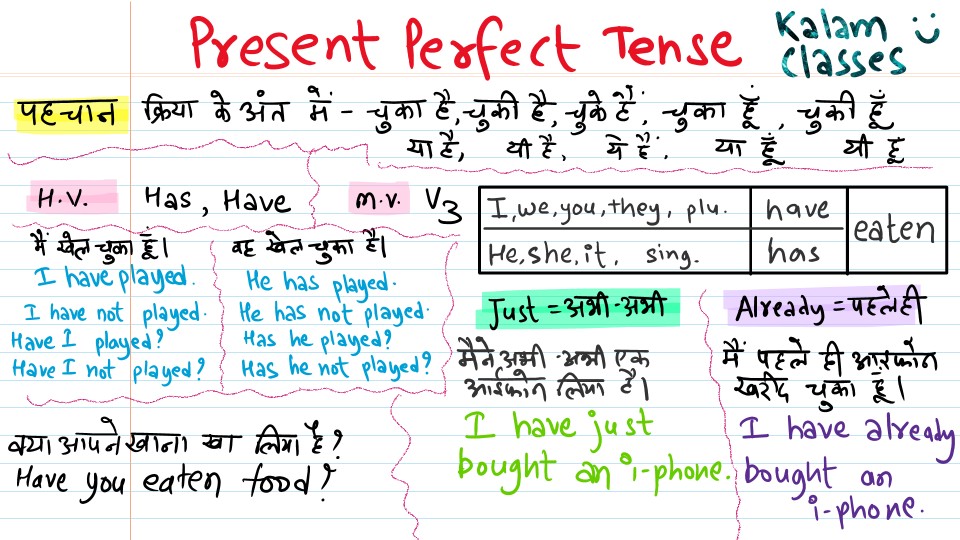
Introduction:
Present Perfect Tense is used to describe actions that have been completed recently or have a connection to the present.
It is formed using
has/have + past participle (V3).
- वाक्य के अंत में “चुका है, चुकी है, चुके हैं, चुका हूँ, चुकी हूँ, या है, यी है , ये हैं, या हूँ, यी हूँ “ जैसे शब्द आते हैं।
- Examples:
- मैंने खाना खा लिया है। (I have eaten food.)
- उसने किताब पढ़ ली है। (She has read the book.)
Structure:
| He/She/It/Child | has |
| I/We/you/they/Children | have |
- Affirmative: Subject + has/have + V3 + Object.
Example: She has finished her homework. उसने अपना होमवर्क कर लिया है. - Negative: Subject + has/have + not + V3 + Object.
Example: She has not finished her homework. उसने अपना होमवर्क नहीं किया है. - Interrogative: Has/Have + Subject + V3 + Object?
Example: Has she finished her homework. क्या उसने अपना होमवर्क कर लिया है? - Interro-Negative: Has/Have + Subject + V3 + Object?
Example: Has she finished her homework? क्या उसने अपना होमवर्क नहीं किया है?
Usage:
1. Recent Actions (अभी-अभी हुई घटनाएँ)
- English: My mother has just made tea.
Hindi: मेरी माँ ने अभी चाय बनाई है। - English: The train has just arrived.
Hindi: ट्रेन अभी आई है। - English: He has already submitted the report.
Hindi: उसने रिपोर्ट पहले ही जमा कर दी है।
2. Life Experiences (जीवन के अनुभव)
- English: I have visited the Taj Mahal twice.
Hindi: मैंने ताजमहल दो बार देखा है। - English: She has never eaten sushi.
Hindi: उसने कभी सुशी नहीं खाई है। - English: Have you ever met a celebrity?
Hindi: क्या तुम कभी किसी सेलिब्रिटी से मिले हो?
3. Past Actions Affecting Present (अतीत की घटना, वर्तमान पर असर)
- English: I have forgotten my password. (Now I can’t log in.)
Hindi: मैं अपना पासवर्ड भूल गया हूँ। (अब लॉगिन नहीं कर पा रहा।) - English: He has cut his finger. (Now it’s bleeding.)
Hindi: उसने अपनी उंगली काट ली है। (अब खून बह रहा है।) - English: The kids have broken the vase. (Now it’s in pieces.)
Hindi: बच्चों ने फूलदान तोड़ दिया है। (अब वह टुकड़ों में है।)
Use of – Just
- “Just” का प्रयोग Present Perfect Tense में तब किया जाता है जब कोई कार्य अभी-अभी ( कुछ समय पहले) पूरा हुआ हो।
Structure (संरचना):
Subject + has/have + just + V3 + Object.
Examples (उदाहरण):
- English: I have just eaten my food.
- Hindi: मैंने अभी-अभी खाना खाया है।
- English: He has just arrived.
- Hindi: वह अभी-अभी आया है।
- English: They have just watched the movie.
- Hindi: उन्होंने अभी-अभी फिल्म देखी है।
- English: I have just taken a bath.
- Hindi: मैंने अभी-अभी नहाया है।
Important Notes (महत्वपूर्ण बातें):
- “Just” का मतलब “अभी-अभी” या “कुछ ही समय पहले” होता है।
- Example:
- She has just left the office. (वह अभी-अभी ऑफिस से निकली है।)
- Example:
- “Just” को “has/have” और “V3” के बीच में रखा जाता है।
- ❌ Wrong: I have eaten just my food.
- ✅ Correct: I have just eaten my food.
Use of – Already
Already पहले ही
“Already” का प्रयोग Present Perfect Tense में तब किया जाता है जब कोई कार्य अपेक्षा से पहले (expected time से पहले) पूरा हो चुका हो।
Structure (संरचना):
Subject + has/have + already + V3 + Object.
Examples (उदाहरण):
- English: I have already finished my homework.
- Hindi Meaning: मैंने होमवर्क पहले ही पूरा कर लिया है।
- English: He has already eaten his food.
- Hindi Meaning: उसने खाना पहले ही खा लिया है।
- English: We have already watched this movie.
- Hindi Meaning: हमने यह फिल्म पहले ही देख ली थी।
Practice Sentences (अभ्यास वाक्य):
- मैं पहले ही यह किताब पढ़ चुका हूँ।
(I have already read this book.) - क्या तुम पहले ही अपना पैकिंग कर चुके हो?
(Have you already packed your bags?) - टीचर पहले ही क्लास में आ चुके हैं।
(The teacher has already come to the class.)
- मैंने अपना होमवर्क पूरा कर लिया है।
(I have completed my homework.) - क्या तुमने कभी समुद्र देखा है?
(Have you ever seen the ocean?) - उन्होंने अभी तक खाना नहीं खाया है।
(They have not eaten food yet.)
- Keywords: Ever, Never, Before
- Examples:
- क्या तुमने कभी ताजमहल देखा है? (Have you ever seen the Taj Mahal?)
- मैंने कभी झूठ नहीं बोला है। (I have never lied.)
- Examples:
- मैंने अपना पर्स खो दिया है। (अब पैसे नहीं हैं।)
(I have lost my wallet. → Now I have no money.) - उसने अपना मोबाइल तोड़ दिया है। (अब वह काम नहीं करता।)
(He has broken his phone. → Now it doesn’t work.)
- मैंने अपना पर्स खो दिया है। (अब पैसे नहीं हैं।)
प्रैक्टिस वाक्य (Hindi → English)
- मैंने आज अखबार पढ़ लिया है।
(I have read the newspaper today.) - क्या तुमने कभी हिमालय देखा है?
(Have you ever seen the Himalayas?) - उसने अभी तक अपना होमवर्क नहीं किया है।
(He has not done his homework yet.)
Your message has been sent

- GRAMMAR QUIZES FOR MP BOARD STUDENTS
- Use of ‘each/every’
- Exercise on Each/Every (3 July)
- Exercise on ‘some/any’
- Aadjective Class 2

 A platform for my students.