
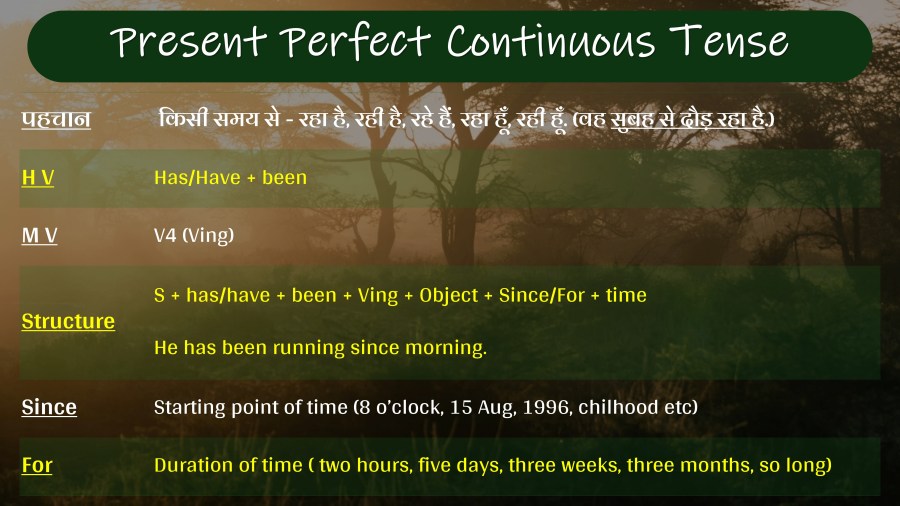

This tense is used to describe actions that started in the past and are still continuing or have just stopped recently, often emphasizing the duration of the action.Present Perfect Continuous Tense का उपयोग उन क्रियाओं (actions) को व्यक्त करने के लिए किया जाता है जो:
- अतीत (Past) में शुरू हुई हों और अभी भी जारी हों
(काम पहले शुरू हुआ और अब भी चल रहा है) - अभी-अभी समाप्त हुई हों, लेकिन उनका प्रभाव/परिणाम अभी दिखाई दे रहा हो
(काम बस खत्म हुआ है, पर उसका असर अभी है)
इस Tense में समय की अवधि (Duration of Action) पर जोर दिया जाता है।
Subject + has/have + been + V4 (Ving) + Object + since/for + time
1. “Since” – Used for a Specific Point in Time (निश्चित समय बिंदु के लिए)
- Refers to the starting point of an action (when it began).
- Used with exact times, dates, or events.
Examples:
- She has been teaching since 2010.
(वह 2010 से पढ़ा रही है।) - I have been waiting since morning.
(मैं सुबह से इंतज़ार कर रहा हूँ।) - They have been living here since January.
(वे जनवरी से यहाँ रह रहे हैं।)
Common “Since” References:
- Since + year (since 2005)
- Since + month (since April)
- Since + day/time (since Monday, since 9 AM)
- Since + event (since childhood, since college)
2. “For” – Used for a Duration of Time (समय की अवधि के लिए)
- Refers to the total period of the action (how long it has been happening).
- Used with general time expressions.
Examples:
- He has been working for three hours.
(वह तीन घंटे से काम कर रहा है।) - We have been studying for two months.
(हम दो महीने से पढ़ाई कर रहे हैं।) - They have been traveling for a week.
(वे एक हफ्ते से यात्रा कर रहे हैं।)
Common “For” References:
- For + hours/minutes (for 2 hours, for 30 minutes)
- For + days/weeks/months/years (for 5 days, for 10 years)
- For + general time (for a long time, for ages)
Comparison Table (Since vs. For)
| Since | For |
|---|---|
| Refers to starting point | Refers to duration |
| Used with specific time | Used with general time |
| Example: since 2015, since Monday | Example: for 5 years, for an hour |
 A platform for my students.