
‘Each’ और ‘Every’ दोनों का मतलब –> ‘हर एक’ या ‘प्रत्येक’ होता है, लेकिन इनके इस्तेमाल में कुछ बारीकियां हैं जिन्हें समझना ज़रूरी है।
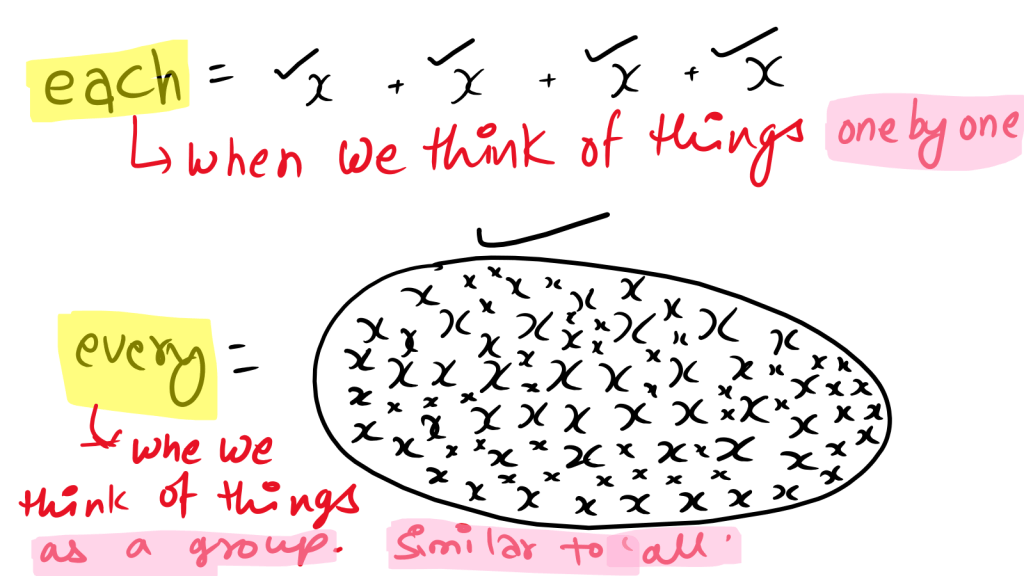
‘every’.
Key Idea 1: ‘Every’ means “all of them” or “without exception.”
यह पूरे समूह पर ज़ोर देता है। यह समूह में मौजूद हर एक सदस्य को देखता है, लेकिन एक सामूहिक इकाई के रूप में।
- Example: “Every student in the class passed the exam.” (This means 100% of the students passed. No one failed.)
- Example: “Every country has its own culture.” (This talks about all countries collectively, each having a culture.)
Key Idea 2: ‘Every’ is always followed by a singular countable noun.
भले ही इसका मतलब ‘सभी’ हो, इसके साथ हमेशा एकवचन संज्ञा (singular noun) का इस्तेमाल होता है।
- Incorrect: Every students
- Correct: Every student
- Incorrect: Every books
- Correct: Every book
Key Idea 3: ‘Every’ is used when we think of things as part of a group, looking at them generally.
जब हम एक बड़े समूह के बारे में सामान्य रूप से बात कर रहे होते हैं।
- Example: “Every house on this street has a garden.” (We’re talking about the general characteristic of houses on the street.)
Key Idea 4: Frequency. ‘Every’ can be used with time expressions to say “how often.”
जब हम किसी क्रिया के बार-बार होने की बात करते हैं।
- Example: “I go to the gym every day.”
- Example: “The train arrives every ten minutes.”
Quick Check (2 minutes):
Fill in the blanks with ‘every’:
- ____ bird has wings.
- She brushes her teeth ____ morning.
- ____ car needs fuel.
‘each’.
Key Idea 1: ‘Each’ means “one by one” or “individually.”
यह समूह के प्रत्येक सदस्य पर अलग-अलग, व्यक्तिगत रूप से ज़ोर देता है। यह हर एक इकाई को अलग करके देखता है।
- Example: “Each student received a different question.” (This implies that we are looking at one student, then the next, and so on, and giving them individual questions.)
- Example: “Each team member contributed to the project.” (We are emphasizing the individual contribution of every single member.)
Key Idea 2: ‘Each’ is always followed by a singular countable noun.
‘Each’ के साथ भी हमेशा एकवचन संज्ञा (singular noun) का इस्तेमाल होता है।
- Incorrect: Each books
- Correct: Each book
- Incorrect: Each students
- Correct: Each student
Key Idea 3: ‘Each’ can be followed by “of the” + plural noun/pronoun.
यह एक महत्वपूर्ण अंतर है। ‘Each’ के साथ हम ‘of the’ का प्रयोग करके बहुवचन संज्ञा या सर्वनाम का इस्तेमाल कर सकते हैं।
- Example: “Each of the students received a prize.” (Here, “students” is plural, but ‘each’ still refers to them individually.)
- Example: “Each of us has a responsibility.”
Key Idea 4: ‘Each’ is used when we think of things as separate items, often in a small group.
जब हम छोटे समूह के सदस्यों को अलग-अलग इकाई के रूप में देखते हैं।
- Example: “There are five books on the table. Each book has a different cover.” (We are looking at each book individually.)
Quick Check (2 minutes):
Fill in the blanks with ‘each’:
- ____ child was given a toy.
- ____ of the two brothers is an engineer.
- There were ten questions, and ____ question was difficult.
Comparing ‘Each’ and ‘Every’ – The Differences Summarized
Let’s put them side-by-side to really highlight the differences.
| Feature | Each | Every |
| Emphasis | Individual items, one by one (प्रत्येक, व्यक्तिगत रूप से) | Group as a whole, all without exception (सभी, सामूहिक रूप से) |
| Number | Often used for smaller, definite groups. | Used for larger, indefinite groups. |
| Usage with ‘of’ | Can be followed by ‘of the’ + plural noun/pronoun. | Cannot be followed by ‘of the’ + plural noun/pronoun. |
| Adverbial Use | Can be used as an adverb (e.g., “The bill is $10 each”). | Cannot be used as an adverb. |
| Time Expression | Not typically used with time expressions to mean “how often.” | Often used with time expressions (e.g., “every day,” “every hour”). |
Let’s look at some examples to solidify this:
- “Every student in the class stood up.” (We are talking about the entire group standing up at once.)
- “Each student in the class stood up one by one.” (This emphasizes the individual action of each student.)
- “Every tree in the forest was tall.” (General statement about all trees.)
- “Each tree in the forest had a bird’s nest.” (You are considering each tree individually to find a nest.)
Why is this important?
आपके लेखन और बोलने में सटीकता लाने के लिए यह बहुत महत्वपूर्ण है। सही शब्द का प्रयोग करके आप अपना मतलब और भी स्पष्ट रूप से व्यक्त कर सकते हैं।
Practice Time!
Let’s do some exercises together. Choose either ‘each’ or ‘every’ to complete the following sentences. Be ready to explain your choice!
- ____ participant received a certificate at the end of the workshop. (Think about whether it’s one by one or all collectively.)
- The doctor advised me to take this medicine ____ four hours. (Hint: time expression)
- ____ of the three sisters is a doctor. (Hint: ‘of the’ + plural noun)
- ____ citizen has the right to vote. (Think about a general right for all citizens.)
- They studied ____ chapter carefully before the exam. (Are they studying them one by one or all at once?)
 A platform for my students.